A quota premium says very little without the quota it was bid against
Every report of a bidding exercise quotes the price. The number that produced it — how many certificates were on offer — is published in the same file and almost never appears beside it.
4 min read
What to take away
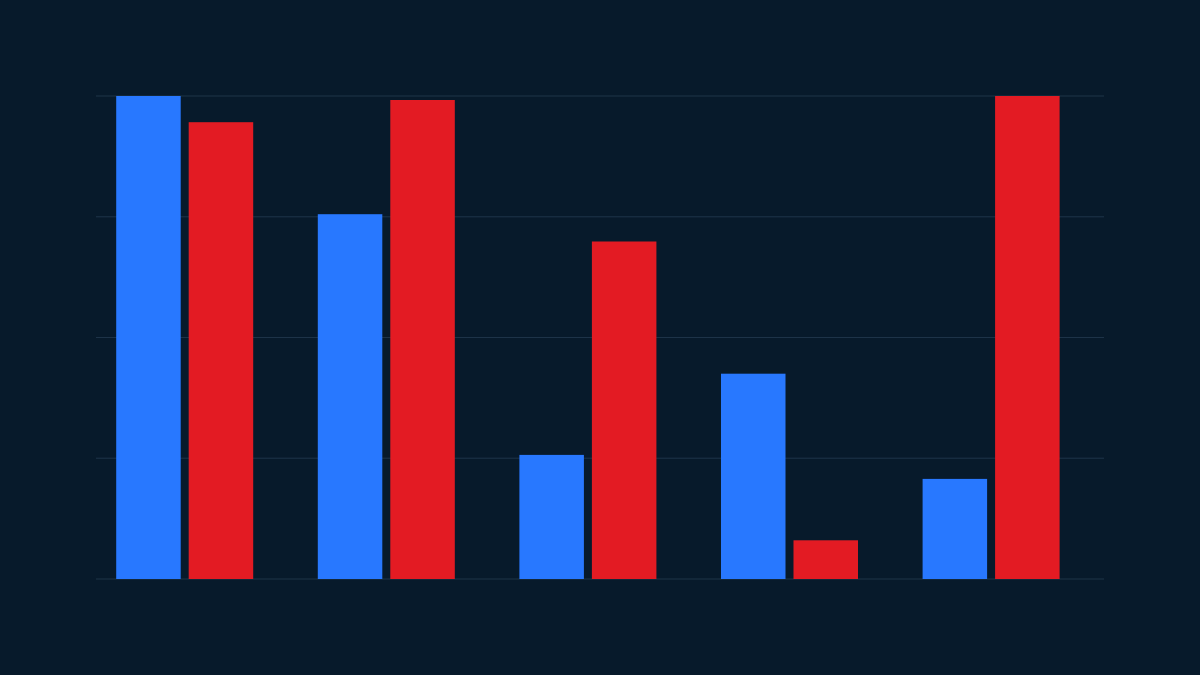
- Category B is 4.9 per cent dearer than Category A and offers 24 per cent fewer certificates. The price difference is smaller than the supply difference.
- The open category, E, closed at S$131,000 — S$1,090 above Category B, which it can be used to register into.
- The quota is published in the same dataset as the premium and is the figure that explains it.
A quota premium is a price for permission, not for a car. The certificate confers the right to register a vehicle for ten years, it is auctioned rather than sold at a set rate, and the number auctioned in any exercise is decided in advance. That last part is the part that gets dropped. A price arrived at by auction is a statement about supply as much as about demand, and the supply figure sits in the same published file as the price.
In the August 2026 exercise, 3,242 certificates were issued across five categories. Category A, for smaller-engined and lower-powered cars, took 1,226 of them and closed at S$123,890. Category B, for everything above those limits, took 926 and closed at S$129,910. That is a price difference of 4.9 per cent against a supply difference of 24 per cent, which is the first thing the pairing makes visible: the two categories are much closer in price than they are in scarcity.
Category C, for goods vehicles and buses, closed at S$91,545 on 315 certificates. Category D, for motorcycles, closed at S$10,503 on 521. And Category E, the open category, closed at S$131,000 on 254 — the smallest allocation and the highest price of the five.
The open category prices above the category it buys into
Category E is not a vehicle class. It is a certificate that can be used to register anything, and in practice it is mostly used for the cars that would otherwise need a Category B. It closed S$1,090 above Category B in the same exercise.
That is not an anomaly to be explained away. It is what a small, flexible allocation does in an auction: 254 certificates that can go anywhere will be bid for by everyone who missed out elsewhere, and the flexibility is worth paying for. But it does mean the highest price in the exercise attaches to the smallest pool rather than to the most desirable vehicle, and any reading of the results that ranks categories by price is really ranking them by scarcity with extra steps.
Where the quota comes from
The number is not a policy dial set by preference each fortnight. The quota is built from the vehicles deregistered in the preceding period plus whatever growth rate is currently allowed, and the Land Transport Authority publishes both the schedule of exercises and the results. An exercise opens at noon on the first and third Monday of the month and closes at four in the afternoon on the Wednesday; the premium is the lowest successful bid, so everyone who succeeds pays the same figure regardless of what they were willing to pay.
Two consequences follow, and neither is intuitive. A category can get dearer while demand is falling, if deregistrations fall faster. And a category can get cheaper in a month when more people want a car, if a batch of ten-year certificates from a busy registration year happens to expire at once. The premium is the output of both halves, and reporting only the output while withholding one of the inputs is how a fortnightly auction result becomes a story about sentiment.
A bidder sees more than the eventual buyer does. The exercise runs as an open auction: the current lowest successful bid is visible while bidding is live, and a bid can be revised upward but never down. So the closing premium is the point at which the last successful bidder stopped, in full view of what stopping cost, which makes it a poor proxy for what anyone thought a car was worth and a good one for how many people were still in the room.
What the record supports
The dataset runs to 197 exercises, from January 2010 to the current month. Over that span Category A rose from S$20,501 to S$123,890 and Category B from S$22,400 to S$129,910 — increases of roughly five times each. The July 2026 exercise was the highest Category A figure in the whole record at S$126,000, which makes the August close 1.7 per cent below its own peak rather than a fall worth a headline.
The quota series is where the interesting questions are, and it is the series nobody charts. A premium that has risen fivefold in sixteen years while the allocation moved in ten-year waves is a story about the shape of those waves. The register holds the quota for every exercise back to 2010 and the deregistration figures that drive it are published separately, by month, which means the correlation is checkable rather than assertable. It has not been checked here, and a premium report that treats the number of certificates as background rather than as the explanation will keep not checking it.
Questions
5 answeredWhat is a Certificate of Entitlement, and what does the premium actually buy?
It is the right to register a vehicle for ten years, auctioned rather than sold at a set rate. The premium is a price for permission, not for a car, and it is settled by bidding against a quota of certificates that is fixed before the exercise opens.
How is the quota for each exercise decided?
It is built from the vehicles deregistered in the preceding period plus whatever vehicle growth rate is currently allowed. It is not set by preference each fortnight, which is why a category can get dearer while demand falls, if deregistrations fall faster.
Why did Category E close above Category B in the August 2026 exercise?
Category E is not a vehicle class but an open certificate that can register anything, and its allocation was the smallest of the five at 254. It closed at S$131,000, S$1,090 above Category B. A small, flexible pool draws bids from everyone who missed out elsewhere, so the highest price attaches to the scarcest allocation rather than to the most desirable vehicle.
Does everyone who wins pay what they bid?
No. The premium is the lowest successful bid and every successful bidder pays that same figure, whatever they were willing to pay. The exercise runs as an open auction with the current lowest successful bid visible while bidding is live, and a bid can be revised upward but never down.
Where can the quota figures be checked?
In the same Land Transport Authority dataset that publishes the premium, which runs to 197 exercises from January 2010 to the current month. The deregistration figures that drive the quota are published separately, by month.
Sources
2 referenced
The Fifth Avenue flagship, and the bronze that travelled to it
The largest Adidas store in the world opened on Fifth Avenue in December 2016. The object unveiled inside it was a copy of a statue in a Bavarian stadium.

The People's Operator: an ethical network that ran out of money
TPO promised to pass 10 per cent of revenue to causes customers chose. Company filings show less than 3.8 per cent of gross income reached them.

The dragon ants of New Guinea, and what X-rays found inside
Two ant species from Papua New Guinea got Game of Thrones names. The reason the paper matters is what microtomography revealed under the spines.